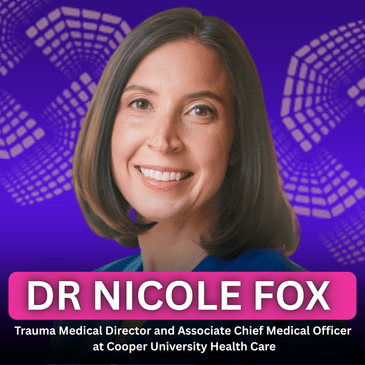
In this episode of The Executive Flow podcast, host Subbu Ramalingam sits down with Dr. Nicole Fox, a Trauma Surgeon and Professor of Surgery who serves as Trauma Medical Director and Associate Chief Medical Officer at Cooper University Health Care, and host of Prognosis Ikigai, a Podcast centered on healthcare professionals who are living their purpose and building fulfilling, sustainable careers.
Dr. Nicole discusses the pressures facing healthcare leaders today, why building resilient organizations requires more than simply adapting to change, and how burnout can often reflect a deeper loss of purpose and alignment. She also explores the concept of Ikigai as an alternative to traditional work-life balance, the role values and coaching play in creating meaningful careers, and how AI could reduce administrative burden and help clinicians spend more time on the human side of medicine.
Expect to Learn:
- Why healthcare leaders need to build organizations that can thrive through constant change rather than simply react to disruption
- How burnout can show up as cynicism, emotional exhaustion, depersonalization, and a loss of purpose
- Why Ikigai offers a different way to think about sustainable careers beyond traditional work-life balance
- How understanding your personal values can help identify misalignment and reconnect you with meaningful work
- Why coaching and continuous learning can help healthcare professionals navigate complex career transitions
- How AI could reduce administrative burden and allow clinicians to spend more time on meaningful patient care
Episode Breakdown with Timestamps:
- [00:00] - Introduction to Dr. Nicole Fox and her dual role as a Trauma Surgeon and Hospital Executive
- [01:53] - Why healthcare is both more exciting and more challenging than ever
- [05:27] - Building resilient healthcare organizations amid constant change
- [06:36] - Nicole’s journey from political science to medicine and systems thinking
- [09:20] - Moving from patient care into healthcare leadership and systems improvement
- [11:24] - Rethinking burnout, moral injury, and the cost of working in healthcare
- [14:55] - Ikigai, purpose, and moving beyond work-life balance
- [19:39] - What leaders who have found purpose and flow have in common
- [24:14] - AI, healthcare workflows, and bringing clinicians back to the human side of medicine
- [32:16] - Three practical ways leaders can begin finding their Ikigai and flow
"Disclosure: Portions of this episode (such as the introduction or promotional segments) use AI-generated voice narration produced under human editorial review.”
Follow the Guest, Dr. Nicole Fox:
- LinkedIn: https://www.linkedin.com/in/nicole-fox-md-mph-cpe-237a2287/
- Company LinkedIn: https://www.linkedin.com/company/cooperuniversityhealthcare/home/
- Company Website: https://www.cooperhealth.org/
The Link to the Ikigai Book: https://amzn.in/d/0h9OeC7W
More from Prognosis Ikigai:
- Website: https://prognosisikigai.com/
- Apple Podcasts: https://podcasts.apple.com/us/podcast/prognosis-ikigai/id1789964935
Follow the Host, Subbu Ramalingam:
- LinkedIn: https://www.linkedin.com/in/subburamalingam/
- Instagram: https://www.instagram.com/subbu_rama/
More from FloWise Leadership:
- LinkedIn: https://www.linkedin.com/company/flowise-leadership/
- Website: https://flowiseleadership.com/
More from ViVega.Health:
- LinkedIn: https://www.linkedin.com/company/vivega/
- Website: https://vivega.health
Follow The Executive Flow:
- Spotify: https://open.spotify.com/show/1Qsl58ueuZBllszimFGK8z?si=2687c2ceea8f4582
- Apple Podcasts: https://podcasts.apple.com/us/podcast/the-executive-flow/id1802953321
- YouTube: https://www.youtube.com/@FloWiseLeadership
[00:00:00] What are the challenges you're facing? Get our viewers into that environment for us. I think this is a time when healthcare has never been more exciting, but it's also never been more challenging. Most people don't know the margins in healthcare of any business are very, very thin. The problem now is that we have to create resilient organizations that can thrive amid constant change. Today's guest is Dr. Nicole Fox, a trauma surgeon and professor of surgery who serves as the trauma medical director and associate chief medical officer at Cooper University Healthcare.
[00:00:28] She is also the creator, host, and CEO of Prognosis Ikigai, where she helps others thrive through coaching, consulting, and podcasting. I hate the word burnout. We're talking about something like burnout. We're talking about those people that have started to become depersonalized. They're very cynical about what they're doing. They're emotionally exhausted and they have a reduced sense of accomplishment in their work. I never really understood or bought into terms like work-life balance. There is no balance. So then I came across the concept of Ikigai and that was right before I went on a trip to Japan.
[00:00:57] The other thing is don't underestimate the value of coaching in your career. So I think career coaching is an unbelievably powerful tool that can help you answer some of the questions you're struggling with yourself. You'll lose your Ikigai again and have to find it. And it's an ongoing process. It doesn't stop. If you could just talk about Ikigai as a concept and then enlighten some of the folks also would be great. So you're going to get me down my favorite path, which is Ikigai.
[00:01:41] Nicole, welcome to the Executive Flow podcast. Thank you. I'm happy to be here. Thanks for inviting me. Excited to have this conversation with you. And this is going to be a very unique conversation compared to the episodes I've had, Nicole, for the audience. Number one, you are a trauma surgeon, professor of surgery. And after we met, found out we're not far away from each other in terms of geography. You're at Cooper University Hospital.
[00:02:10] And, you know, I'm in Philly. We're right across the river. There are so many things that we would like to get your thoughts on based on where you're sitting as professor and also a trauma medical director and also a leader in this industry. For my listeners and the Executive Flow podcast, to hear about your journey, a quick introduction about you before we dive into some of our topics. Sure. I mean, we can get into it on the podcast.
[00:02:38] I, as you said, I'm a trauma surgeon and I'm also a hospital executive. So I tell people that I live this dual existence where I get to work in the system and work on the system at the same time. I have been at the same place for the last 16 years. And so I've sort of seen the evolution of health care, obviously, before that in my training and have a lot of unique opportunities and responsibilities in the workplace. And so I already got a sneak preview into some of the things that you want to talk about. And I'm excited to get into the conversation.
[00:03:07] Awesome, Nicole. First is, I will just jump in right is the health system environment right now. First and foremost, from where you sit, you see patients and your team sees patients with severe trauma. And you also work with your colleagues, clinicians, non-clinicians who are going through burnout. And there's all the AI and other things in health care. How does the landscape look right now?
[00:03:35] From where you sit from as a trauma medical director, associate chief medical officer, what are the challenges you're facing? How did us get our viewers into that environment for us? Sure. So I like to say that I think this is a time when health care has never been more exciting, but it's also never been more challenging. So it's a time of extraordinary opportunity. And then there's a lot of complexity layered on top of that. So when I think about what I've seen in health care in the last 25 years, there's been remarkable advances in medicine, technology.
[00:04:06] Patients are living longer. They're surviving illnesses we once thought were untreatable. And they're benefiting from all the innovation, which is now at a rapid pace. And you mentioned AI and some of the other things that are coming down the pike. At the same time, it's a really complex system. Health care is one of the most complex systems we have in the United States. Most people don't know the margins in health care of any business are very, very thin. Resources are finite. And so even seemingly small operational or financial changes can cause a significant impact.
[00:04:33] So really every day it is a battle. Every day it's making really hard choices to continue to deliver the kind of care that we want to deliver to keep patients safe and to keep the engines running. It's not like any other business that people are familiar with. So it's awesome, but it's hard. Mention about the margins. You know, this is something that I go through. It also, not many people know about like the thin margins, you know, whether it's health systems or health plans and other organizations operating, right?
[00:05:00] Small percent from a scale perspective, it just moves significant cost both on the upside and the downside, you know, at the same time. I also love the optimistic perspective, right? So if you define the challenge right now, what is the biggest structural pressure? You talked about health structure, complex, you know, structure for leaders to navigate. The main reason for this Executive Flow podcast is having a clear view despite the noise, right?
[00:05:27] There's so much noise that leaders go through. And then having that ability to kind of really cut through the noise and get to clarity is the focus, you know, of the podcast, right? So in terms of defining the problem, what is the biggest structural pressures you see for health system leaders right now that people outside, you know, healthcare don't see? Well, you kind of hit it right on the head because I think we talk a lot about adapting to change and the need to adapt to change. And that's a great talking point, right?
[00:05:57] But it's so much more than that because I think the problem now is that we're trying to create or we have to create resilient organizations that can thrive amid constant change. So the disruption is going to be constant. Like you said, the noise is going to be constant. The change is going to be constant. And especially as time goes on, that's just going to worsen.
[00:06:13] So the question is, how do you work every day on ensuring that your organization is capable of withstanding those changes, that they're resilient, that the work they're doing does not become distracted by the noise and they can continue to ebb and flow as changes occur without completely breaking down? That's the biggest pressure that I think patients don't see.
[00:06:34] I think people outside of healthcare don't see is you're almost rebuilding the system in a way because the way that we did things 10 years ago, 15 years ago, certainly 20 years ago are not going to carry us into the future in healthcare, particularly in regard to things like our workforce and how we run day-to-day operations. So that is a huge pressure that hospital executives face now. You know, from that, Nicole, your leadership journey, right? So just a double flicking on your initial intro, right? So you started in political science before medicine.
[00:07:01] How did that shape the leader you became over time? So love to hear your personal journey before you came into the health system in that environment. Sure. I think that I have to be honest that the political science situation was a default. I found that when I got to, although I wanted to be a surgeon since I was 11 years old, that was a decision I made really early in life. I found that I wasn't enjoying most of the classes that were required for medical school, right? I just didn't like it. I couldn't understand they're relevant. And I'm not a STEM-focused person. I mean, that's just the truth of the matter.
[00:07:32] So that forced me to start thinking really early outside of the confines of a career in medicine and preparing for med school. Like, how could I still get to the destination but maybe do it a little bit differently and be happier? I gravitated towards political science because I enjoyed systems-level thinking. I loved the discussions that we were having in class. I loved the reading and having more of a balanced educational experience. So the political science thing was never intentional.
[00:07:55] I defaulted to it, and then it was probably the best decision I ever made because it really changed my trajectory as an undergraduate student and sort of set a path forward. I can relate to this a little bit in a different way. I've been an undergrad in physics, right? And then did a master's in computers and also in a business. I was in the financial world for a few years and then came into healthcare. Completely different world. And then I'm in population health. And I love that systems thinking part of it, right?
[00:08:23] So I think there's the distinction between one-on-one patient care, you know, thinking about systems, thinking about populations. And that's actually, I feel like it's a, both are equally important, connecting to one-on-one and then able to zoom out in how this impacts all our population and so forth. I think that's just a critical part of leadership in strategic thinking.
[00:08:45] So you also have, apart from being the role that you're in, and you also are doing work around ikigai. And so from a leadership perspective, walk us through that arc for us, right? And how did both fruition at the same time? Yeah, it was funny because you had a question about the arc of your journey, right? And everybody asked you to encapsulate your career into like three or four sentences. And well, that's a 21-year journey, right?
[00:09:12] It could be like completely separate podcast of how I got from political science to prognosis ikigai, which is my podcast and which is my business. I always tell people I started my career, the absolute focus was on being the best trauma surgeon I could be. That was it. That was the goal. But in doing that, I kept encountering problems that needed to be solved. I would just stumbling along in my day-to-day clinical work. And they weren't just clinical problems because sometimes those are the easiest problems to solve, right? Or we do some research around it and we find a way.
[00:09:39] But these were system-level problems. And I think that's what naturally led me into leadership roles, like being the pediatric trauma director, which was one of my first leadership roles, being the associate chief medical officer in my current role. And it led me to this place where I could work in the system, like I told you, while working on the system at the same time. And you said it really nicely, like zooming out and zooming in. Yeah. Which takes a certain type of personality and a certain type of interest in doing that.
[00:10:06] And it ultimately led me to this place with Prognosis Ikigai where I'm so passionate about helping others in healthcare build meaningful and sustainable careers. So reaching that point where they kind of understand, depending on how involved they want to get in it, that they're working within a complex system and how do they navigate that. So when I think about the arc of my career, I think about it as a transition from or an evolution from caring for patients to leading systems to then helping other people thrive within those systems and navigate those systems.
[00:10:35] Using all the knowledge that I've gained, whether it's clinical, whether it's clinical, whether it's leadership, whether it's systems thinking, to now really helping other people navigate. And I do all of that on a daily basis with the people that you work with. It's not just one thing a day. Exactly. That is awesome, Nicole. Just shifting gears a little bit. Burnout for leaders is a big challenge, right? So burnouts could be different things for different people, you know, depending on the profession and all that, right? And the burnout of the surgical team is a real challenge, right? So walk us through this, right?
[00:11:05] How does burnout actually look like in a trauma team, right? And how is it different from a burnout from a boardroom, kind of like high-stake, white-collar situation, right? You know, walk us through that because I think it's in the burnout with the surgical team and the amount of people that are type of people you all interact with. It's like, you know, that itself is like a whole, you know, different nuance to it. So help us understand how does that burnout look like?
[00:11:34] Well, first of all, I hate to disappoint you, but I hate the word burnout. I have publicly spoken about my distaste for that word for a long time. And I think the reason for that is because it's so much more complex than a term like burnout, right? We will attribute that to people, oh, they're burned out. They're, you know, with physicians in particular or people, and not just physicians, but people in healthcare, we know that when we're talking about something like burnout, we're talking about those people that have started to become depersonalized, right? They're very cynical about what they're doing.
[00:12:00] They're emotionally exhausted, and they have a reduced sense of accomplishment in their work. Those are really the three characteristics of people who we then categorize as burned out. I see it show up in so many different ways in healthcare. It can be small things like a person's frequently late to the office or they're not completing their charts or it's starting to catch up with them. That's always a concern. But then there's very dramatic things that happen with people, sexual harassment, violence in the workplace, divorce, alcoholism, suicide.
[00:12:27] So there's a spectrum of how this burnout, moral injury, whatever you want to call it, shows up. And it can be of varying degrees at varying times in someone's career. And some people never experience it. This like isolated few that just go through their career and they say, I've never felt that way. They're very lucky because as you said that what we do, I give a lot of talks publicly about the cost of service, what it costs to do the kind of work we do, to see people dying, to see families forever changed by a traumatic event.
[00:12:56] And to see like the physicality of what that looks like sometimes is very disruptive. But keeping that life can certainly lead you down a path of a burnout, moral injury, whatever term you prefer to use. That is something that has more and more attention has been given to, particularly since the show The Pit, which I think does a tremendous job portraying a physician who really is struggling mightily with some of these questions of why am I here? Do I even want to be here? Why do I do this anymore? That's burnout.
[00:13:25] That's kind of losing purpose. Yeah, certainly. That's a whole deeper topic in itself in terms of the rule class. It is. It really is. Jumping into how you as a leader help, you know, other folks and some tools and tips for folks to really exercise their leadership, connect back to their purpose.
[00:13:45] I think most folks, I feel no ikigai, but at the same time for the sake of folks, if you could just talk about ikigai as a concept a little bit and then enlighten some of the folks also would be great. So you're going to get me down my favorite path, which is ikigai. But I think what happened to me is that I never really understood or bought into terms like work-life balance or work-life integration.
[00:14:08] It made no sense to me, particularly work-life balance, where you're trying to tell people that there should be a balance. There is no balance, right? There's times when work is important. So then I came across the concept of ikigai, and that was right before I went on a trip to Japan, and it was to speak at the World Trauma Congress, I think it was back in 2023. And my aunt handed me this book called Ikigai. It's a fantastic book. And it described this concept, which is really where you have reached this place where everything has intersected.
[00:14:34] You're doing what you love. You're doing what you're good at. It's something that the world needs. And you're able to make a living off of it, honestly, which is important, right? We have to support ourselves. That made a lot of sense to me. Instead of talking about work-life balance, work-life integration, I thought, well, how do we get people to a place where they are doing what they love? They're doing something that's important. They're getting paid. That's really the goal instead of trying to trap them into these corners.
[00:14:58] So that's how I got there, and that's how I really started to lean into ikigai and talk about it and then help others try to work towards that intersection for themselves. Yeah, that's awesome. I think I've read the book, Ikigai, you know, there are multiple ones a few years ago, and that was awesome. And then I think right after you went to Japan in 2023, I was in Japan early in 2024. It was sort of like also a spiritual trip. You know, my cousin lives in Japan, and then I haven't seen him in a while.
[00:15:27] And literally, I had that, you know, there was a follow-up book called Ikigai, like a workbook, right? The first book was more about, like, Ikigai, the concept and all this stuff. And then I literally bought that Ikigai workbook at the airport. You were on it. You were ready to go. Yeah, it was awesome. It all kind of like made, to your point, made complete sense because I do love my work. And integration also felt like a little bit like how I'm doing, like multitasking and I'm not doing justice.
[00:15:57] One of the things as part of the Executive Flow podcast, right, we focus on a lot around tapping into flow states. Which is Ikigai, right? When what you're doing doesn't feel like work and things like that. Yeah. Yeah. No, Ikigai seems like kind of the foundation, right? If you find the Ikigai, you know, whatever your and your purpose is and you're connected to it, you're doing that work, we all go through it. Like, when you're tuned in, like, distractions doesn't even matter. Like, you know, distractions come in and boom, like, you are, like, tuned in.
[00:16:25] And the flow state enables that. And from a neurological perspective, and also there's a lot of practice. So in your experience, you yourself as a leader and you working with other leaders, give us some examples. People who have found Ikigai and, like, found the flow in their work really made a difference. Not only for the people around them, for themselves, but also ultimately the patient care, you know, in the trauma situation.
[00:16:50] Because it translates not only self-care for that person, the whole aura around that person, but also, like, outcomes for the work that person does for people. Right. So your question is more to not necessarily finding your Ikigai, but what does it look like when someone has found that and is kind of working in that space? Exactly. I mean, well, that's a great question because what you generally see is the opposite, right? We're so focused on the people that are not there yet and helping them get there.
[00:17:19] So I tackle the very question you're asking me right now when I started my own podcast. This is not a plug, but I'm just going to give you an example. What I started doing, because I was dealing with so many physicians who were unhappy with their work, who didn't have their Ikigai, etc. I decided for my own purposes, I was going to talk to people in health care who had been doing it for a long time, who had successful and fulfilling careers, who loved what they did, who had figured it out. They were living their Ikigai. They were fulfilling their purpose and they were loving their work, right? And what does it look like?
[00:17:48] Well, first of all, it looks like a very energetic, very highly functioning leader in whatever space they're leading in. There's someone that other people turn to to problem solve. There's someone that other people will look at and say, hey, they really helped me get from here to there. They serve as sponsors. They serve as mentors. They're often very visible in their national organizations and outside of their chosen field. They generally have a huge impact on people.
[00:18:13] And a lot of times their focus is so much more on impact rather than anything else, rather than chasing titles or things like that. But I did find that there were commonalities amongst all these people that have found their Ikigai. These are people who actually took a lot of time to get to know themselves. They did the really hard work of digging down and trying to figure out what they should be doing with their time. Where were they the most impactful? Where were they making a difference?
[00:18:41] And where did they feel like they were in their flow state? And they chased that really hard. All the people from CEOs to successful pharmacists to nursing leaders, like it ran the gamut. My guests run the gamut, but they all are people. And some of them are doing totally different things than they start. Because I always ask from their journey from the day that they entered medical school or nursing school or whatever to where they are today. They could have never seen themselves. They're doing so they had to accept the fact that the road was going to take them.
[00:19:10] If they were really following their Ikigai and doing things they were passionate about, that road might lead to places that they didn't expect. And that was OK. So they changed course a number of times. They started over. They failed. They got back up. I think that's what it looks like. It's a process. Not just with one day where you figure it out, but like ongoing. Because you'll lose your Ikigai again and have to find it. And it's an ongoing process. It doesn't stop, which can be really frustrating for some people because they just want to figure it out and be done.
[00:19:37] What I find all the time, you know, helping other leaders and helping my teams, etc. And helping myself and working on myself is I could have the best routine in terms of like, oh, sleep, optimizing, physical health, meditation, etc. If you don't exactly are aligned with your purpose, any amount of like, you know, longevity work and cold baths, you know, sauna. None of those don't work. Right.
[00:20:07] Once you're aligned and then use other optimization, obviously sleep and other things, it's just like you're doubling it up because there's that, like you said, the inner alignment is already there. Boom. Like no matter what, you wake up, you know, and refreshed. Absolutely. Well, I'm glad you brought up the word alignment because I think that's really important to talk about when you talk about Ikigai, which is it is when you're aligned with your values, when you're aligned with your what's interesting to you.
[00:20:34] When you find yourself unsettled or out of flow, a lot of times it's an alignment issue and you have to really ask yourself, where is the disconnect here? Where am I getting off track? And that takes time to sit down and actually think about that and not just keep rushing through the day. And it's a constant process. Like you said, it's just this could be one and like you're coming back and, you know, wrapping up. That's awesome. I love that. So I want to jump into AI, AI and related stuff. AI could do a number of different things, in my opinion, for leaders.
[00:21:02] So it could really use of the appropriate AI, could reduce a lot of time for preparation. You know, so many other things you can automate using agentic AI and all those stuff, right? But at the same time, it also, you know, from a healthcare perspective, it could create bias potentially if it's not governed properly. It could have all kinds of challenges.
[00:21:26] I mean, I think there are studies out there, Nicole, recently, you know, the last few years, you know, especially a lot of people even more using, you know, AI kind of makes it neurologically. So they are so different. They rely on AI more and their natural intelligence of, you know, human brains is lost. And, you know, I worry about that from our human species that are moving forward with it. So there are a lot of unknowns, right?
[00:21:50] In your opinion, from balancing AI with clinical and human work, what are you seeing that AI is helping right now in healthcare? How do you see, you know, that's really it's empowering your teams? And then how do you see the future as well from your perspective? Yeah, that's a big topic. I wonder if I listen to this 10 years from now what I'll think of what I say. But AI to me is transformative. It's revolutionary. It definitely can make you more focused, more efficient, improve workflow, no doubt.
[00:22:19] Like any other tool, and we're used to this in healthcare because we investigate new technology all the time. The last thing you want to do in an environment like healthcare is say, well, this is the way we've always done it. There's no reason to change. That is the wrong mentality to have, whether you're talking about a new cancer drug, whether you're talking about a new device, or whether you're talking about AI. So it's here. People are using it. And we have to figure out how to apply it responsibly in our field.
[00:22:42] I think for healthcare, it's a no-brainer that AI is a net positive because there's so many things right now that physicians and nurses and other people in healthcare complain about. Administrative hassle, time spent charting, all these extra things that have nothing to do with why we went into healthcare. And they take us away from where we really want to be, which is at the bedside with the patient in the operating room. So I choose to look at AI, where can we put AI that we don't want to be anyway so that we can be where we need to be?
[00:23:11] Interacting with our patients and their families, having difficult conversations, spending more time on the human element. I think none of us would deny that that's what we want to do and stop trying to choose codes or worry about the billing on the back end or trying to devise the perfect note in the chart. If we can have AI solutions to those things and serve as the human element, I think it can, I actually think all these things we're talking about, burnout and all these, this might be one of the biggest antidotes to some of the problems that we've been facing.
[00:23:40] Because it's going to help us work smarter and get us back to the core of doing what we really went into healthcare to do. If you think about a physician 50 years ago who went from home to home with their black bag and got to speak to families. There's a purity in that. And there's a value in that. We have really, we have lost it. I mean, I can tell you how rushed I am with families. Even despite my best efforts, it's like you're constantly trying to move to the next thing. You have completing charts looming over your head or the next administrative meeting.
[00:24:08] AI has the potential to transform all of that and bring us back to the place that we need to be so some of these other problems will go away. Now, very optimistic way of looking at it, I know, but I prefer to take that lens rather than just be worrying about all the negatives, like you said, which are real, replacing critical thinking skills and stuff like that. That's a problem. It's interesting. Just last week, I had this discussion with, you know, health system CEOs. He described to me this situation, right?
[00:24:37] All his docs are like back-to-back appointments, 10, 15 minutes or eight minutes, whatever, right? You know, back-to-back, there's that cortisol building, you know, to get to the next appointment. And then, like, suddenly, I mean, if, you know, within the clinical workflow, things are, like, haphazard, there's, like, a wrong diagnosis and all that things that are coming up, it just adds to that stress that the doctors are already facing. I think it was Friday.
[00:25:03] I was having this conversation, and you were exactly describing that problem. And I think I love that optimistic approach. AI could really, a proper good AI, you know, implementation could really help the physicians. I do think that, to your point, there's a lot of, if you think about getting ourselves educated in how to use AI, there's a lot of opportunities there.
[00:25:27] And I would say a quick plug, you know, also, that is one of the areas that me and my team also works on. You know, yeah, implementation, the right time in a clinical care setting, you know, and for leaders. So I'll put the link out there, you know, for folks to kind of reach out if they want to understand how to kind of, like, be ready for it, you know, how to implement it. But I feel like that's in healthcare. We both, I'm in the payer side mostly, and also in the value-based care side. So many, though, hanging fruits.
[00:25:54] Absolutely. So many workflows that can be managed through AI and get people where they need to be, whether it's revenue cycle, clinical care, operations, across the board. Would it be awesome if a doc clinician goes to a lonely patient out there who needs clinical care, and then the doctor goes there, sees the family, sees what's happening, the traditional stuff? I miss that. I mean, I used to have that back in India. My doctor, we used to call him.
[00:26:24] So my dad used to call him, and I was just, like, had a cold when I was a kid. The moment we called him, and then the moment he comes in to our house, he would start, this doctor would say, hey, he would just say there's nothing to worry. That's how he starts the conversation. Bam. Bam. Bam. Bam. Bam. Bam. Bam. Bam.
[00:27:15] Bam. Bam. Bam. Bam. Bam.
[00:28:10] Bam. Bam. Bam. Bam. Bam. Bam. Bam. Bam.
[00:28:51] Bam. is an unbelievably powerful tool that can help you answer some of the questions you're struggling with yourself rather than someone just mentoring you and telling you what to do. A coach will try to drive you towards some of these answers on your own. Coaching in healthcare is a fairly new concept. Executives use coaches forever. It's a tool that, you know, most of the C-suites hire coaches for their executives, but we never really thought about it with physicians, nurses, people on the
[00:29:17] front lines. Coaching is incredible. That's number two. I would investigate that if you haven't done it. Number three is really, to me, has been developing a good reading list of things outside of healthcare. You know, writers like Adam Grant and Simon Sinek and people that have written about things like playing the infinite game, learning to think again, leaders eat last, like broadening your education outside of just the day-to-day what you learn in your job. A reading list is really critical
[00:29:46] and we have so much access now with audible books and, you know, you can listen to them on the ride in the ride out. Continuing your own professional development journey, whether you're in the insurance industry, whether you're in the hospital, whether you're a teacher, I mean, that to me is really, really important. So I guess number three would be start building your reading list and read. And for my podcast guests, at the end of each episode, I ask them for their recommendation for the podcast reading list. And there's been some tremendous books. Do you have a recommendation? I always recommend
[00:30:15] the infinite game by Simon Sinek. I think that of anything I read really shifted my mindset because in healthcare in particular, we're really taught to think logarithmically, like you check this box, then this box, then this box. And really, what game are you setting yourself up for? Do you want to be doing this career for as long as you can? Or do you want to just race through it and then find yourself really unfulfilled? So the infinite game reset that for me and made me realize like, what game am I trying to play here? Which is to do this for as long as I can.
[00:30:44] That's awesome recommendation. That's a great book. We'll put the link also in the show notes, Nicole. I have a recommendation, an author you also mentioned, which is one of my favorite authors, is Adam Grant, who's a Philly guy. Many of us is good. I think, again, it's a really good one. I think he's got a couple coming, you know, also, but Think Again is a, I love Think Again. Well, you know what? Also, just to add to that with Adam, he's been doing a podcast with Brene Brown,
[00:31:11] and she's someone who has a great values exercise. If you're trying to look for a values exercise to do, I wouldn't have mentioned that, but you said Adam Grant, and then I thought of him, and they're very complimentary. And so her, Brene Brown's values exercise is a really easy one to do and sort of hone in on what your poor values are. No, that's a good call out. I've actually just listened to a couple of those, their collaboration episodes. I think it's, you're right, very complimentary to each other. You know, it's awesome. They have their own unique personalities, which is really, really cool.
[00:31:38] This is great. Those three recommendations are fantastic. And the second one and third one, Nicole, I want to double down on that one. I personally had a major transformation through GetUp Coaching, back in the day. It may sound biased. That was one of the reasons I actually started in an executive flow is it made a huge difference for me personally. It's hard to put an ROI directly, right away, because people just think about like, oh, you got to pay this, pay this,
[00:32:06] but like it is, it compounds over time. And last but not least, the book, I mean, in the age of, you know, reels and, you know, bite-sized information, reading for the entire book and really processing that is, goes a long way. That's what they say, leaders are readers, right? You know, to your point. Amir Kasai says that. And I think it's important because you may say, well, I've read all this
[00:32:35] before, or they're just saying the same thing over and over again. But I have to tell you, if you're going to talk about concepts like ikigai or thinking again or values, those books help you articulate to other people what you're trying to convey. So they, these are thought leaders in these fields that have put a lot of time and effort into researching this. This is their ikigai. This is their life. So it will help you be more convincing if you're mentoring people, sponsoring people, leading people to convey these concepts. You know, you have to sort
[00:33:03] of understand them yourself. And I think the reading list really helps with that. Fantastic. Nicole, this was awesome. Thank you so much for coming on to the podcast. We'll also put a show note on your podcast as well for folks to listen to. I really appreciate the conversation and thoughts and hope to do it again. Yes, I appreciate you reaching out. Thank you so much. Thank you.