In this episode, Subbu Ramalingam, President at ViVega.Health and Founder at FloWise Leadership, breaks down a sharp question most leaders are quietly avoiding: what is the role of leadership when AI can already do most of the work.
The episode explores how artificial intelligence is reshaping work, decision-making, and value creation, while arguing that the real edge is still deeply human. Things like judgment, trust, vision, and wisdom are not going anywhere, no matter how smart the machines get.
Key Takeaways:
- Leadership is shifting from control to clarity: AI can handle execution-heavy tasks, but leaders are now expected to create direction, meaning, and alignment rather than just manage output.
- Human trust is becoming the real competitive advantage: In a world flooded with automation, the ability to build trust through consistency, honesty, and presence becomes more valuable than technical skill alone.
- Questions are more powerful than answers: Great leaders are not the ones giving instructions all the time. They are the ones asking questions that unlock thinking and help others generate insight.
- Wealth is a reflection of value creation, not something separate from service: The episode challenges the idea that wealth and service are opposites. When value scales, wealth naturally follows.
- AI amplifies leadership instead of replacing it: AI increases speed and capability, but judgment, empathy, and ethics still sit with humans. The strongest leaders combine both.
- Curiosity is no longer optional: Leaders need to keep learning constantly because the environment is changing too fast for fixed knowledge to stay useful.
Episode Timestamps:
[00:00:00] – AI and the future of leadership: Intro to how AI changes leadership and why human skills still matter
[00:04:14] – Asking better questions: Great leaders unlock thinking through powerful questions
[00:05:40] – Wealth and value creation: Wealth as a result of value, not separate from service
[00:07:10] – Curiosity and learning: Continuous learning is essential in fast-changing systems
[00:08:14] – Future leader mindset: Service, curiosity, and human-AI balance define future leaders
🔗 Connect with the Host Subbu Ramalingam:
👉 LinkedIn: https://www.linkedin.com/in/subburamalingam/
👉 Instagram: https://www.instagram.com/subbu_rama/
🔗 Connect with the Host Company, FloWise Leadership:
👉 LinkedIn: https://www.linkedin.com/company/flowise-leadership/
👉 Website: https://flowiseleadership.com/
🔗 Connect with the Host Company, ViVega.Health:
👉 LinkedIn: https://www.linkedin.com/company/vivega/
👉 Website: https://vivega.co/
🔗Follow the podcast:
👉Spotify: https://open.spotify.com/show/1Qsl58ueuZBllszimFGK8z?si=2687c2ceea8f4582
👉Apple Podcast: https://podcasts.apple.com/us/podcast/the-executive-flow/id1802953321
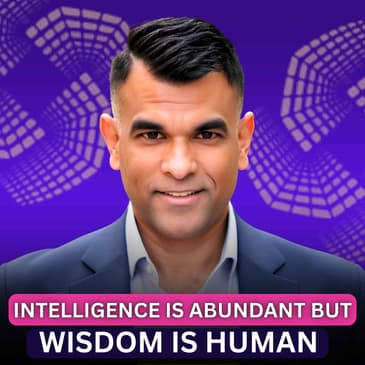
[00:00:00] If AI can do most of the work, what becomes the role of a leader? We are entering a world where intelligence is going to be abundant, but wisdom, judgment, trust, vision, those are still human. Artificial intelligence is changing how we work, how we create value, and how we lead as humans.
[00:00:21] In a world filled with algorithms, human trust will be the ultimate competitive advantage. Today, I want to talk about three critical shifts every leader must take right now.
[00:00:34] First, let me ask you a question. Imagine you wake up tomorrow and the majority of your daily tasks can be done faster, cheaper, and more accurately by artificial intelligence.
[00:01:05] Reports, analysis, strategy modeling, writing, coding, and even decision support, all of it. Now, here's the real question. If AI can do most of the work, role of a leader, because we are entering a world where intelligence is going to be abundant, but wisdom, judgment, trust, vision, those are still human.
[00:01:30] And the leaders who thrive in the next decade will not simply be the smartest people in the room. They'll be the ones who know how to create clarity, inspire people, ask powerful questions, and build systems where humans and AI can work seamlessly together. In other words, the future belongs to leaders who can operate in the executive flow.
[00:01:55] Today, I want to talk about three critical shifts every leader must take right now. First, embracing a service-oriented leadership mindset. Second, developing a mindset for wealth, value creation. And third, becoming a leader who can thrive in the age of artificial intelligence and be more human, because technology may transform the world, but leadership will determine whether the transformation benefits humanity and nature. So let's dive in.
[00:02:24] Welcome back to the Executive Flow podcast. This podcast is about helping leaders reach a state of clarity, presence, and flow so they can lead organizations and lives that create real impact. Today, we'll talk about something deeply important for leaders right now. We are entering one of the most transformative moments in human history.
[00:02:46] Today, artificial intelligence is changing how we work, how we create value, and how we lead as humans. But here's the truth. Technology alone will not define the future leadership will. And the leaders who thrive in the next decade or beyond embody three things. A service-oriented leadership mindset, a healthy relationship with wealth and value creation, and the ability to lead humans and AI together.
[00:03:14] Today, I'm going to walk you through a framework that integrates all three. Number one, service-oriented leadership. Let's start with the foundation. Leadership is service. Too often, leadership is framed around authority or power. But the greatest leaders in history understood something very different. They understood that leadership is about lifting others. Service-oriented leadership asks a simple question. Who am I here to help succeed? Not how do I look powerful?
[00:03:44] How do I create conditions where others thrive? When leaders adapt this mindset, something interesting happens. Trust increases. Engagement increases. Innovation increases. Because people feel seen. People feel valued. And when people feel valued, they perform at a completely different level. And this is just not hearsay. This is also proven by science. Foundation number two, the power of transformative questions.
[00:04:14] Now, one of the most powerful ways leaders serve others is through the right questions. Not by having all the right answers, but by unlocking insight in others. Research and coaching in neuroscience shows something fascinating. When someone generates their own insight, the brain produces a burst of high-frequency neural activity that creates stronger learning and lasting behavioral change.
[00:04:42] This is why the best leaders don't simply give instructions. They ask questions that unlock thinking. Questions like, what opportunity are we not seeing yet? What problems are we solving for humanity or the organization or the community? What would success look like a time frame from now? Great leaders create what some coaches call the epiphany pocket. A moment where a question lands and silence follows. And in that silence, insight emerges.
[00:05:13] So the next time you lead a meeting, lead a conversation, try asking a powerful question, and then do something that feels uncomfortable. Let the insight emerge. Foundation number three, the wealth mindset. Now let's talk about something that many leaders struggle with, wealth. Some leaders have conditioned to believe wealth is selfish, but that is misunderstanding. Wealth is simply also a measure of value creation.
[00:05:43] If we create solutions that help millions of people, wealth follows. Think about this. Every major innovation history, from electricity to the internet and AI, created enormous value for humanity and the people who built these systems created wealth. The real question is not, is wealth is good or bad? The real question is, what value are you creating for the world? Service and wealth are not opposites. They are partners, in my opinion.
[00:06:11] When you serve people at scale, value grows. Pillar number four, leadership in the age of AI. Now let's talk about AI. Because the leaders who succeed in the next decade will understand one thing, AI does not replace leadership. It could amplify leadership. AI can process information faster than humans, but it cannot replace judgment, ethics, empathy, vision. Those are human capabilities. They will become more valuable and not necessarily less.
[00:06:41] The future could belong to leaders who know how to combine human intelligence, artificial intelligence, and collective intelligence. It's easier said than done. The best leaders will ask questions like, how AI can help our team become more creative? How can we remove repetitive work so humans can focus on innovation, uplifting others? The leaders who ask these questions will build extraordinary organizations. Pillar number five, curiosity and learning.
[00:07:11] Another essential leadership trait in the AI era is curiosity. Technology is evolving rapidly, which means leaders must become continuous learners. Curious leaders ask questions like, what don't I understand yet? What new technology should I explore this month? What emerging ideas could reshape my industry? Curiosity is not just a personality trait. It is a leadership discipline.
[00:07:39] And it keeps you thinking fresh. Pillar number six, building trust in an AI world. As AI systems are becoming more powerful, trust becomes even more important. People need leaders they can trust. Leaders who are transparent. People are leaders who can act with integrity. Trust is building through small actions, keeping promises, admitting mistakes, listening deeply.
[00:08:08] In a world filled with algorithms, human trust will be the ultimate competitive advantage. Pillar number seven, the future leader. So what does the leader look like? They are service-oriented, technologically aware, and deeply human. They understand wealth is value creation. They ask questions that unlock insight. And they build organizations where human and AI systems work together to create extraordinary impact.
[00:08:36] Before we wrap, I want to leave you with one question. If you had access to the most powerful technologies in history, what kind of leader would you choose to become? If you want to explore that deeper, I created an executive flow self-assessment. You can take it by clicking on this website. It will help you understand where you are in your leadership journey and how to grow. Thank you for listening to the Executive Flow podcast. Until next time, stay curious, serve others, and lead in flow.