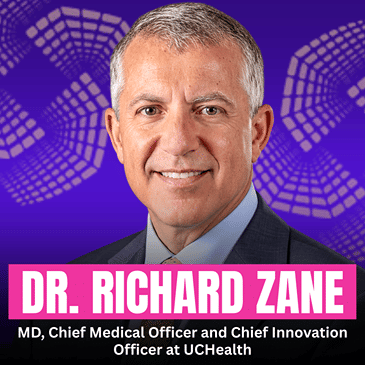
In this episode of The Executive Flow podcast, host Subbu Ramalingam sits down with Dr. Richard Zane, MD, Chief Medical Officer and Chief Innovation Officer at UCHealth, a Colorado-based health system focused on patient care, research, education, and innovation across hospitals and clinical services.
Dr. Zane discusses how healthcare leaders can build organizations that innovate without creating unnecessary bureaucracy, why leaders should fear inaction rather than failure, and how AI is already changing clinical care, operations, documentation, and executive decision-making. He also explores where humans should remain in the loop, the challenges of regulating AI in healthcare, how leaders can manage stress while staying connected to mission, and the leadership principles that have guided his career.
Expect to Learn:
- Why healthcare organizations should fear inaction rather than failure when pursuing innovation
- How leaders can turn frontline healthcare problems into scalable solutions through pragmatic innovation
- Why AI’s ability to recognize patterns and evaluate large numbers of variables could transform clinical decision-making
- Where the human should remain in the loop as AI becomes more deeply integrated into healthcare
- How AI is already being used across clinical care, documentation, hospital operations, and executive leadership
- Why positivity, accountability, delegation, decisiveness, and a strong connection to mission matter for healthcare leaders
Episode Breakdown with Timestamps:
- [00:00] - Introduction to Dr. Richard Zane and leading healthcare innovation
- [01:18] - Dr. Zane’s unconventional journey from aspiring motocross racer to physician and healthcare executive
- [05:59] - Leading as both Chief Medical Officer and Chief Innovation Officer
- [09:45] - Why healthcare innovators should fear inaction, not failure
- [13:30] - AI as pattern recognition and why healthcare is uniquely positioned to benefit
- [17:08] - The human in the loop, AI adoption, and the challenge of healthcare regulation
- [21:11] - How Dr. Zane uses AI across patient care, clinical operations, and leadership
- [23:43] - Managing stress through family, mission, and perspective
- [25:17] - The unsolved healthcare problems AI could help uncover
- [27:01] - Leadership lessons for current and aspiring healthcare executives
"Disclosure: Portions of this episode (such as the introduction or promotional segments) use AI-generated voice narration produced under human editorial review.”
Follow the Guest, Dr. Richard Zane:
- LinkedIn: https://www.linkedin.com/in/richard-zane-md-9b87b5a/
- Company LinkedIn: https://www.linkedin.com/company/uchealth/
- Company Website: https://www.uchealth.org/
Follow the Host, Subbu Ramalingam:
- LinkedIn: https://www.linkedin.com/in/subburamalingam/
- Instagram: https://www.instagram.com/subbu_rama/
More from FloWise Leadership:
- LinkedIn: https://www.linkedin.com/company/flowise-leadership/
- Website: https://flowiseleadership.com/
More from ViVega.Health:
- LinkedIn: https://www.linkedin.com/company/vivega/
- Website: https://vivega.health/
Follow The Executive Flow:
- Spotify: https://open.spotify.com/show/1Qsl58ueuZBllszimFGK8z?si=2687c2ceea8f4582
- Apple Podcasts: https://podcasts.apple.com/us/podcast/the-executive-flow/id1802953321
- YouTube: https://www.youtube.com/@FloWiseLeadership
[00:00:00] The delivery of healthcare is pattern recognition. I think I'm a medium, smart doctor. I can adjudicate four to eight variables at the same time. And most people are around like that number. And if they're exceptional, what's 13? AI can adjudicate millions, trillions, billions. So think about that. Pattern recognition and variable adjudication at infinity scale. It's just made for medicine. Today, it takes on average three and a half years and seven counters to diagnose immunologic problem. AI should be able
[00:00:26] to do that in five minutes. Today's guest is Dr. Richard Zane, an MD, Chief Medical Officer and Chief Innovation Officer at UC Health, a nationally recognized nonprofit healthcare system with operating revenue of $10 billion and a workforce of more than 37,000 people. Innovation also sometimes comes with certain risks. So how as a leader you are handling that? Number one, abhor bureaucracy. Two is create solutions that benefit people. And the third is fear inaction, not failure. If we
[00:00:56] didn't have innovation failures, we weren't trying hard enough. Full stop. I went home and I googled Chief Innovation Officer. I got an article from Forbes magazine that said, if you want to be an innovative organization, fire your Chief Innovation Officer. The last thing a Chief Innovation Officer has to be is the source of all innovation. Anthropic and Open Evidence just announced a partnership to take medical AI to 100 countries. So what are the different two or three unsolved problems in healthcare that you
[00:01:25] see AI could really solve in our lifetime? I think that there will be. Welcome to another edition of the
[00:01:50] Executive Flow podcast. Today, I have the honor of having Dr. Richard Zane to this podcast for a great conversation on leadership, AI, adoption as an organization, and also using AI as a leader. Welcome to the podcast, Dr. Zane. Thank you for having me. I'm thrilled to be here.
[00:02:15] Excellent. So Dr. Zane, you're Chief Medical Officer, Chief Innovation Officer at UC Health. And before we hopped on to the conversation when we did the call, I learned a lot from you. First of all, love the glasses and colors. I made sure that I contrast two different colors going on. And for the audience, if you could just share your background a little bit more and journey around
[00:02:44] how you got to this role and a little bit more about it would be awesome to start. Well, it's long and circuitous. I think that the key theme throughout my career has been taking advantage of unique opportunities and being pragmatic. I'll start from the very, very beginning. I was born in Switzerland. I lived in Italy until I was in first or second grade. I moved to New Jersey, then middle school and high school in pretty rural, not rural now,
[00:03:12] but rural Pennsylvania, and came home one day and told my dad that I was going to be a professional motocross racer and that I wasn't going to go to college. And much to my surprise, he was pretty circumspect and said, well, how are you going to support yourself? And I said, well, I'm going to live here. And he said, you can live here, but you know, there's things like insurance and gas and food. He said, why don't you work in one of the warehouses I manage while you're preparing to
[00:03:39] be a professional motocross racer? So I worked in a warehouse that he managed for three days, came home and said, dad, I want to go to college. And at the time I only looked at schools I was being recruited to play football for. So I ended up going to a small school in Baltimore, Johns Hopkins, and study writing. And then in the middle of my first semester of my senior year, my advisor said, you know, if you switch your major to natural sciences, you can graduate early. So because I'd
[00:04:06] done science classes as my electives, I graduated early from college and spent a semester really hanging out and tending bar and being a bouncer in a really great bar where I met a lot of girls. And then my roommate was applying for teaching jobs. So I applied for a teaching job and I was elementary school teacher. And while I was an elementary school teacher, I realized that that
[00:04:31] wasn't going to be a permanent thing for me. So I had applied to medical school, graduate school, and law school. And I went to a new teacher's conference where I met my wife, who is now a practicing pediatric orthopedic surgeon. And she was applying to medical school. And to be honest with you, I went to medical school to impress my wife. And when I went to medical school, I didn't even know that you had to do residencies. And throughout the processes, I decided to do
[00:04:57] emergency medicine. I trained in emergency medicine in Baltimore at Johns Hopkins, did a fellowship in emergency medical services, ended up working with their helicopter program, which was a lot of fun. And then my wife did a fellowship in pediatric orthopedics. And I followed her to New England and spent 14 years after starting off with a one-year temporary job at Brigham and Women's in Harvard Medical School. Where I learned a lot about administration and systemness and innovation. And then was recruited
[00:05:25] out to Colorado in 2012 to be the inaugural chair of the Department of Emergency Medicine. And in the middle of that is when, with a partnership with a woman named Kimberly Muller, who runs innovation for the academic system, discovered that if I partnered with companies and helped them iterate, helped them assimilate into workflows, it was better for me and better for them. And then discovered a term called
[00:05:53] participating in value creation, which Kimberly taught me about. And that meant that I could have a piece of the company if I did something good for them. And then around that time, we were doing it over and over again, the CEO of the health system asked me to do it for the health system and be the chief innovation officer. So a number of years later, I became the chief innovation officer. And then I eventually stepped down as chair, kept the innovation role and then added the chief medical officer role and switched employers. Went from the university to the health system. And currently I'm the chief medical
[00:06:23] officer and chief innovation officer. That is an awesome story, Dr. Zain. So we have some common threads there. But before I ask, I think it looks like it's very impressive and I'm sure you impressed your wife all through the way. Well, funnily enough, we were married for 33 years and have three kids and so far so good. Yeah, you sure did. So Dr. Zain, look, you know, for folks who are actually listening to this and I'm looking at your
[00:06:49] corner office, you know, there, right, beautiful view. And you talked about your journey and your dual role of being both chief medical officer and chief innovation officer. And in this role, you all, you're doing a lot of trade-offs, right? You're the innovation side. And also you have, you know, as a chief medical officer in your organization, overseeing medical directors, doctors, you know, and all that, right?
[00:07:17] So if you could highlight as a leader, how you see the challenges of this dual role and also like opportunities and unique perspectives you get because you're in this dual role. When I was first asked to be the chief innovation officer, it sounded incredibly compelling to me. And I accepted the job and then I went home and my wife had known all along. I was having this conversation with the CEO about this job.
[00:07:46] And then I went home and I sort of Googled chief innovation officer. I got an article from Forbes magazine that said, if you want to be an innovative organization, fire your chief innovation officer. So that was the first article I read about being a chief innovation officer. And it was a pretty compelling message, which was the last thing a chief innovation officer has to be is the source of all innovation.
[00:08:08] So if you set yourself up as every idea has to come from you or through you and you are a gatekeeper, you are going to fail. So that was an important message for me. So that's the last thing I did. And I always was as pragmatic and finite as I could be. My lens is as a physician, I ran a large clinical operation with 25 emergency departments and 27 urgent care centers, large virtual health center.
[00:08:34] And I had clinical and academic credibility and I used all of those to advance the innovation strategy. But we as an organization are very fond of saying that our innovation strategy is our quality strategy, is our IT strategy, is our informatics strategy and our virtual health strategy.
[00:08:51] So it's really intertwining innovation into everything we do. And now as chief medical officer, I have more direct contact and more direct exposure to all of the challenges facing a health system. So I think that they're very symbiotic. I have oversight for quality, safety, regulatory, clinical care delivery, clinical operations.
[00:09:14] And there isn't a single part of health care that doesn't require innovation. Just simply health care must be innovated or it's not going to be sustainable. And there isn't two or three or four big problems in health care. There's a thousand point one percent problems in health care. So for us, we are very specific on what we focus on intelligence. So innovation and intelligence, two terms that mean everything and nothing.
[00:09:40] But for us, it's making better decisions. And those better decisions are either choosing pharmacotherapy at the bedside all the way to how to deploy capital, how to better operationalize infusion centers, really everything in between. And we think about how we partner with outside companies to do that. We very specifically partner with companies from tiny to publicly traded large companies and everything in between.
[00:10:03] Right. That's awesome. So, Dr. Zain, like as part of your journey and your current role, right, in each of these areas that you oversee, you know, obviously, so fantastic symbiotic relationship you mentioned, you know, what's happening in the ground situation in every area. You can see how, you know, not only you and as you articulated really well, innovation doesn't have to come from the top. It has to be, you know, in the fabric and DNA of the organization.
[00:10:30] So as part of this, you're probably also seeing a lot of, you know, what we call as build, buy and kill, right? So pilots, governance, how do you actually look at from an innovation angle, things that could fail, right? Things that really could fail and things that could be successful. How are you handling that?
[00:10:50] Because you are, as an organization, taking care of so many patients and the stakes are really, really high at an individual level and at a population level. So innovation also sometimes comes with certain risks. So how, as a leader, you are, you know, handling that? And what would you advise other leaders who are listening to this in a conversation to think about that? So first, we have some pretty high level overarching guiding principles.
[00:11:20] So for our Care Innovation Center and innovation in general, number one, abhor bureaucracy. Two is create solutions that benefit people. And the third is fear inaction, not failure. If we didn't have innovation failures, we weren't trying hard enough. Full stop. The other is I hate the term pilot. I don't like pilot because it means that it's temporary. It means that if you can just get to the end of the pilot, maybe it can be gone and you don't have to do it.
[00:11:49] We talk about phase deployments and iteration. So from how we pick what we're going to do, we try and be pragmatic. In fact, we've been described as hyper pragmatic, which means we have a very standard way in which we describe the problem that we're trying to solve. And the best identification of problems comes from the people who are doing the actual work at the front lines of finance, at the front lines of nursing, at the front lines of clinical operations, at the front lines of operation. And then we'll take the problem statement.
[00:12:17] We will codify it in a structured way. And then we'll do an environmental scan. And it may just be that it's a problem for us, but other places have solved it. In which case, I don't have to reinvent the wheel. I just have to copy it. And I'll send a team or I'll go myself or I'll have a conversation with another health system or another provider or another provider group and ask them how they've approached the problem. And I will import, iterate, and that is not an innovation. So that innovation and innovative. Innovation is new to the world, innovative, new to us.
[00:12:46] So I try and focus on innovation, new to the world, and introduce folks to others so that they can be innovative for us, even if it's been solved somewhere else. So once we have a problem statement, we do an environmental scan of who may be a good partner for us to solve this problem with. And our best partners, our most successful partners, are one where we are a customer, we are a co-developer, and we participate in value creation.
[00:13:13] Meaning we either make an investment in the company or we have some type of financial relationship so that if they're successful, we are successful as well. We are very comfortable being customer number one, but we build for customers two through 2,000. So we know that not everything is going to work, that not everything is going to work just for UC Health. Meaning it has to work for other places. Places may not have a single mature instance of electronic health record. They may not have a group of health system engineers.
[00:13:40] They may not have pretty enlightened CEO and board. So we know that if the solution is going to work, it must scale. And scale is of no use to us because it'll work for three or six months and if it doesn't scale, it goes away. So that's our approach. Yeah, that's a fantastic framework. And I mean, several are golden tidbits. And one thing that all stood to me is fear in action, not failure. That's a really good one. Thank you, Dr. Zain. So I want to shift into with AI.
[00:14:09] I mean, innovation could be not a lot of different things, including AI, right? And the concept, especially from a clinical standpoint in the healthcare, the human in the loop. I think if you think about AI, you know, you have autonomous automation, machine learning component, and then you have intelligence and you have agentic AI.
[00:14:30] And when you think about, you know, keeping clinicians and human in the loop, and I think it is totally clear, especially in the healthcare environment, that we need to put, you know, more time onto clinicians' hands so that the person can do time and empathetic care to the member of the patient.
[00:14:50] But would love your thoughts on how you all thinking on the human in the loop, you know, with respect to any AI, empowered innovation, all you got going on. So I think that was a big, giant question. And the way I'd love to answer it is to start small. As I mentioned, for us, innovation is intelligence, and intelligence is making better decisions. AI is math. It is not magic.
[00:15:17] And despite all the pundits' pontifications about the end of the world, I think it's largely an immensely positive development in healthcare. And healthcare desperately needs it to be successful. So if you think about the delivery of healthcare and you think about AI, there's a lot of similarities. So the delivery of healthcare is pattern recognition.
[00:15:39] When I see a patient and I practice medicine, I'm using air quotes for those that are just listening and not looking, practice means that I've seen that 10 times. Now I've seen it 100 times. Now I've seen it 1,000 times. And what's important is the more you see it, the easier you recognize it, but you also recognize what doesn't fit into it. AI is pattern recognition over and over and over again.
[00:16:01] AI is also variable adjudication, which is what humans do as they take care of patients. They adjudicate variables. I think I'm a medium, smart doctor. I can adjudicate four to eight variables at the same time. On my best day, maybe eight. On a bad day, two. And most people are around that number. And if they're exceptional, you know, like genius level exceptional, it's 13.
[00:16:25] AI can adjudicate millions, trillions, billions, depending on what next chip NVIDIA is going to build. So think about that. Pattern recognition and variable adjudication at infinity scale. It's just made for medicine. Today, it takes on average three and a half years and seven counters to diagnose immunologic problem. AI should be able to do that in five minutes, maybe. So I think AI is going to be amazing for healthcare.
[00:16:51] If I were young in my career, I would be incredibly enthusiastic, the opportunities of AI. But your question was about a human in the loop. So we think about AI in different categories. First, AI means different things to different people. And if you ask 10 people their definition of an AI, you'll get 17 different definitions. So is it computational linguistics? Is it machine learning? Is it prescriptive algorithms? Is it what I think you're talking about, which is large language models? Yeah. Right.
[00:17:20] So if we're talking about large language models and we think of AI, I have patients and administrative opportunities. So administrative automation is blocking and tackling for AI. How to do REM cycle. Right. How to help with email. How to schedule patients. That sort of thing. In the patient side, I divide the patient side into two categories. Patient as a customer. How to get an appointment. How to get your insurance claimed.
[00:17:48] How to get reimbursed or how to make a payment. How to get directions. What's the number for the specialist? Can I make an appointment? So AI, where patient as a customer, need not have a human in the loop. AI, where patient is a patient. Making a diagnosis and writing a prescription or making a recommendation for testing is where we are paying most attention to where and if a human has to be in the loop.
[00:18:17] Right now, today, this second, a human is in the loop. AI touches a patient without a human overseeing that decision. And I say hope, not anticipate, I hope that is not going to be required in the next 10 months, 10 years. AI is pretty remarkable at making diagnoses, writing prescriptions, and adjudicating variables. Yeah. It's amazing. Like, you know, I love the optimism also, right?
[00:18:43] Because it's also evidenced by, you know, you're seeing it as an opportunity from a patent drug insurance standpoint and the validation standpoint. Now, as we speak, Dr. Zin, just before I joined, you know, our recording just 30 minutes ago, I just heard that Anthropic and Open Evidence just announced their partnership to take medical AI to 100 countries. And this is just like one, you know, to your point on how the opportunities in medicine,
[00:19:13] you know, with AI is, it is just incredible. And I think the human in the loop, you know, clearly, I love the, you know, the way you're thinking about it. But at the same time, it's interesting, you know, Dr. Zin is, you mentioned, we don't know whether it's 10 months from now or 10 years from now. I think what you were saying there is the technology could go so fast or there could be some major risks that comes up.
[00:19:39] But if it comes so fast and it also in the risk is mitigated, the human in the loop factor could reduce. Is that where, you know, how you're seeing it? Not sure that that's accurate. I think the biggest barrier to AI fulfilling its proximate potential in healthcare is regulatory oversight and burden. The state of Colorado, where I live in practice, was mentioned as a cautionary tale of how not to regulate AI.
[00:20:09] And we were literally within days or weeks of having a bill in the state legislature outlaw the ability to use electronic health records. That's how regressive the thinking around AI has been in the state of Colorado. Now, at the 11th hour, there was a carve out for HIPAA compliant entities, which we are. So that gave us a pass. But imagine that you write a regulation that doesn't understand AI, that is going to outlaw
[00:20:38] technology that's been in place for decades. You know, things like how you surface an allergy of a patient. I'm going to write you a prescription for the toprolol and it says you're allergic to beta blockers and I'm not allowed to see that anymore. That is absurd and ridiculous. So the thoughtlessness with which regulation is promulgating for many things, let alone AI, is debilitating and paralyzing and making health care even harder.
[00:21:06] Do you think, Dr. Zain, is that because of the, you know, back to what you mentioned, you know, is the fear of inaction should be the fear of inaction and not fear of failure? Is it because there are folks who are actually part of the regulators, you know, fearing so much that there's our lack of skills and they're just putting a lot of regulatory roadblock?
[00:21:32] The reasons that I was given for the regulation of AI was that there would be biases surfaced. And the examples that were given to me were nonsensical, absolutely, utterly nonsensical. Finished science from decades earlier that wasn't a bias. It's out of health care. And, you know, a bias of, let's say a patient has HIV. Well, HIV is a diagnosis. It is not a bias.
[00:22:00] It does inform the types of medicines that you give someone and the types of therapies you offer them. It's not a bias. It's part of medical diagnosis. So the hyperpolitical embellishment of what bias would be in health care is just not sheated. Yeah, certainly interesting. Don't worship gears a little bit from regulation on Dr. Zain and now on the clinical side.
[00:22:26] And just move into how you're using AI as a leader, your operating system. So how do you use AI now to increase capacity and also improve as the leader and also making you more informed? What do you do? I'll divide it into three categories. My role as an administrator, my role overseeing clinical operations, and my role as a physician taking care of patients.
[00:22:54] So my role as a physician taking care of patients is AI is embedded into our electronic health record. It's embedded into the way in which radiologists prioritize reading studies. It's embedded in how we follow incidental findings like a lung nodule or a thyroid nodule in really everything we do. And then even though different providers will say different things, I have not met a single
[00:23:20] provider that hasn't used AI at least once in every single day. And that doesn't include our ambient AI technology, which creates notes for providers. We're working now with another company to do ambient visual documentation. So they look at what a provider is doing and create a documentation. Forty percent of an inpatient nurse's time is spent documenting. We can do other things with his or her time.
[00:23:45] Then as a clinical operator, we use AI to help us think about how to better organize infusion centers, how to schedule operating rooms, how to do capacity management across 15 hospitals, how to transfer patients, really all of that. And then from an administrative perspective, I use AI every single day to help me organize meetings, write letters of recommendation, work my calendar, prepare presentations, write
[00:24:13] synopses, do data analytics, think about quality, safety, clinical decision support, all of that. Fantastic. So as part of this, right, it's a related topic, Dr. Zain. So one of the things that in the podcast we focus on is person's ability to tap into the state of flow. State of flow, meaning everything is ticking neurologically for the person and is in a fluent
[00:24:41] mode, whether at work or life in general. In the emergency medicine and lots of doctors and lots of clinicians, there is stress. You know, I put in use, burnout here. I mean, burnout is too much misunderstood. Stress and result period. So as a leader, you know, wearing two hats, you know, also still practicing. How do you manage stress? Apart from using AI to kind of like augment, you know, yourself, how do you manage stress?
[00:25:09] And what do you recommend to your teams as a leader to manage stress? I don't think I've ever had very specific conversations about stress, but people know my leadership priorities. They know what's important. So first and foremost, your family comes first, right? I don't ever expect anybody to put me or anyone else ahead of their family. The second is take a minute, take a breath and understand what we're doing, which means
[00:25:39] that when we come to work and we do a good job, people don't suffer and people don't die. That's pretty remarkable. Who else gets to do that in their life is have a mission where when they do a good job, people's lives improve. It's pretty fun and it's pretty remarkable. The other is think about, you know, your day to day and what is time dependent and what is not.
[00:26:04] I don't, I have a team of remarkably skilled adults and I don't tell how to live their lives, but they know that what's important to us is our patience and our mission. That's awesome. Connecting the mission and I love the recommendation of the POS, the power of the breath of the POS. Connecting both of that is awesome, Dr. Zain. So if you think about the next, you know, few years, depending on how fast technology
[00:26:31] goes, what are the different unsolved problems, two or three unsolved problems in healthcare that you see AI could really solve in our lifetime? And if you think that, will that be so awesome, right? If we can solve that problem. I think that there will be disease states that are defined because of AI. I'll give you a few examples from our past. People thought that syphilis did not exist, right?
[00:27:00] Or people thought that patients with tertiary syphilis, where they were becoming altered or paralyzed, that it was an invented psychiatric disease, which it was not. Multiple sclerosis was called intermittent hysterical paralysis. Hysterical because it mostly affected women and because it was intermittent paralysis, it's an actual disease. I think that there are lots of things that we have broad categories of and we have not
[00:27:27] figured out either the mechanistic or biologic source. AI will allow us to do that because we will be able to look at hundreds of thousands of patients with similar constellation of symptoms and find a singular unifying cause. That is going to happen. I can't tell you what disease it is. I can probably say it's in the immunologic, rheumatologic, neurologic, endocrinologic category.
[00:27:57] But other than that, I can't tell you. But before I retire, there will be a new disease that is defined with a treatment that has always been thought to be a constellation of other things without treatment. That's awesome. So, Dr. Zane, if you have a medical director or a chief medical officer who's new to the job or someone who's aspiring to be like you, wearing two hats and you've done a lot of
[00:28:24] work over the years and you're very articulate and thoughtful. If someone wants to be a leader like you, where should they start if they're in the mid-career? So, I'm very fond of saying that if you've met one chief medical officer, you've met one chief medical officer. Meaning our roles are quite different across different hospitals and health systems. Not to be adjorative in any way, not what I'm going to say, but people will say the same thing. If you've gone to one Unitarian church, you've been to one Unitarian church because they're all different.
[00:28:52] So, for me, I have always said that what I'm going to do is going to have the lens of a physician. Meaning I see the world after being a father and a husband and a son and a brother and a friend. My lens is a physician. So, I think about how am I better going to improve the lives of the people that trust themselves to our care? And then everybody has sort of leadership actions and traits that they think are important to them.
[00:29:19] For me, I think positivity and enthusiasm are a leadership trait. Our job is to be positive and enthusiastic. It's really easy not to like something. And you can be cool. You can be one of the cool kids by criticizing something or telling everybody how something's not going to work. But that's not worship. That's pessimism. And anybody can be a pessimist. The other is be proactive. Get out there. Be the first or the second. Build teams and let them grow, which means you have to understand how to delegate.
[00:29:47] So, I hire smart people to tell me what to do. I don't hire smart people to tell them what to do. Try and be approachable. Sometimes it can be difficult when you have a title. So, you have to be extra approachable. And the higher you get up in an organization and the more acronyms you have after your name and describing your title, the more what you say is almost broadcast. So, if you make a comment, think about it through a megaphone. Others are basic blocking and tackling. Do what others expect of you and what you expect of others.
[00:30:16] Be accountable and make decisions. My job is to make decisions. So, more is lost by indecision than bad decisions. And when they're not great, to own it and pivot. That's it. Not complicated. That is awesome. You know, starting with the positivity and all the different things that you mentioned. I think that's an awesome framework, Dr. Zane. First of all, thank you so much for your time. This has been a very good conversation.
[00:30:39] And I want to appreciate you for your clarity, you being very succinct and also motivational without being too zealous and bringing the positivity in as a physician and in medicine, being optimistic about AI and giving a really pragmatic frameworks for leaders to follow. So, and any final thought? If you're in innovation and you're in healthcare, you have to feel the mission.
[00:31:08] You have to get out of bed every day knowing that the job you do makes a difference in other people's lives and they are depending on you. So, it is not a time to think about how you keep your job. It's a time to think about how to do your job. Excellent. That's a great place to wrap up. Thank you, Dr. Zane. My pleasure. Take care and thanks for having me. Thank you.